

Neurophysiotherapy
Rehabilitation after a stroke, injury or neurological diagnosis — working towards movement, independence and confidence, at whatever stage you are at.
Call To Book 07346 812150Rehabilitation built around what you need to do
Neurological rehabilitation is about function. Not exercises for their own sake, but the stairs, the chair, the walk to the car, the hand you need to use.
Ashwini's Master's degree is in Neuro Physiotherapy, and her early career was spent in dedicated neurological rehabilitation settings. That grounding shapes how this part of the clinic works: assessment first, goals set by you, and a programme practised in the ways you actually need to move.
Progress in neurological rehabilitation is usually measured over months, and most of it happens between appointments. That is why the home programme and the people around you matter as much as the sessions themselves.
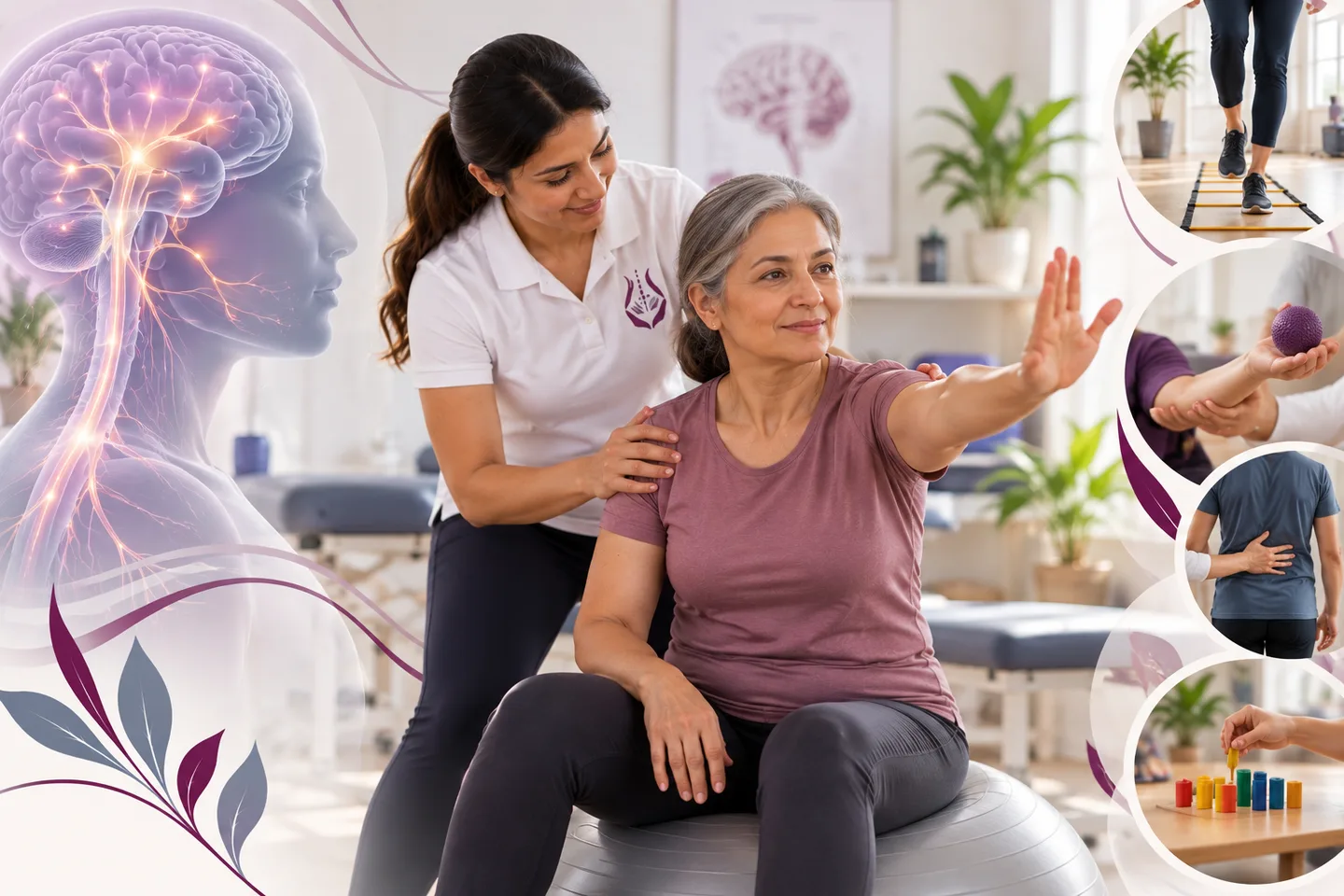
Conditions we work with
These are the diagnoses and difficulties people come to us with. If yours is not here, call and ask — the list is what we see most often, not a limit.
- Stroke
- Paraplegia
- Guillain-Barré syndrome
- Cerebral palsy
- Parkinson's disease
- Multiple sclerosis
- Spinal cord injury
- Traumatic brain injury
- Peripheral nerve injury
- Functional neurological disorder (FND)
- Balance and coordination disorders
- Mobility and walking difficulties
- Neurological weakness
- Falls and reduced confidence
Understand → Restore → Empower
Understand
A detailed assessment of movement, strength, balance, tone, walking and the specific tasks you are finding difficult — alongside your history, your home setup and what matters most to you.
Restore
Task-specific rehabilitation: gait retraining, balance and coordination work, strength and mobility, transfers, posture and upper limb rehabilitation, practised in the ways you actually need to use them.
Empower
A home programme, guidance for anyone supporting you, and the confidence to keep going between appointments — which is where most of the gains in neurological rehabilitation are made.
What rehabilitation may involve
Chosen for your goals
Which of these apply, and in what order, comes out of the assessment and out of what you tell us you want to be able to do.
We will be honest with you about what is realistic and how long it is likely to take. You are better served by an accurate picture than an optimistic one.
- Gait retraining
- Balance and coordination
- Strength and mobility
- Functional movement practice
- Falls prevention
- Transfers
- Posture
- Upper limb rehabilitation
- Home exercise programmes
- Confidence building
Questions people ask
How is this different from general physiotherapy?
Neurological rehabilitation works with movement problems that come from the brain, spinal cord or nerves rather than from an injury to the joint or muscle itself. The approach is task-specific and repetitive, and progress is usually measured over months rather than weeks.
Is it too late to start?
Rehabilitation is often most intensive early on, but people do make progress a long way down the line, particularly on specific functional goals. It is worth an assessment to find out what is realistic in your situation.
What kind of goals do people set?
Usually something concrete and personal — managing the stairs at home, walking to the shop, getting out of a chair unaided, using an arm to eat with. We build the programme backwards from the goal rather than working through generic exercises.
Can a family member or carer come with me?
Yes, and it often helps. Someone who supports you day to day usually has useful information, and learning the home programme alongside you makes it far easier to keep up.
Can you see me at home?
Please call 07346 812150 and we will answer this for you directly.
Will you work with my consultant or NHS team?
With your consent, yes. We are happy to write to your GP, consultant or community team so that everyone involved is working towards the same goals.
How many sessions will I need?
Neurological rehabilitation usually runs over a longer period than musculoskeletal work, and the honest answer depends on your condition and your goals. We give you a clear plan with timeframes after the assessment.
Talk to us about neurological rehabilitation
Call for a free, no-obligation discovery call. It is often the easiest way to work out whether we can help before you book anything.
Call To Book 07346 812150