

Dizziness · Vertigo · Balance
Vestibular Rehabilitation
Assessment and retraining for dizziness, vertigo and unsteadiness — delivered by a physiotherapist certified in vestibular rehabilitation.
Call To Book 07346 812150What it is
Retraining the system that keeps you steady
Your balance depends on three things agreeing with each other: your inner ear, your eyes, and the sensors in your joints and muscles.
When one of them stops reporting accurately, the brain receives conflicting information and the result is dizziness, vertigo or a feeling of being unsteady on your feet.
Vestibular rehabilitation is a programme of specific, graded exercises that help the brain recalibrate to the signals it is getting. It is not a general balance class — what you are given depends on which part of the system the assessment points to.
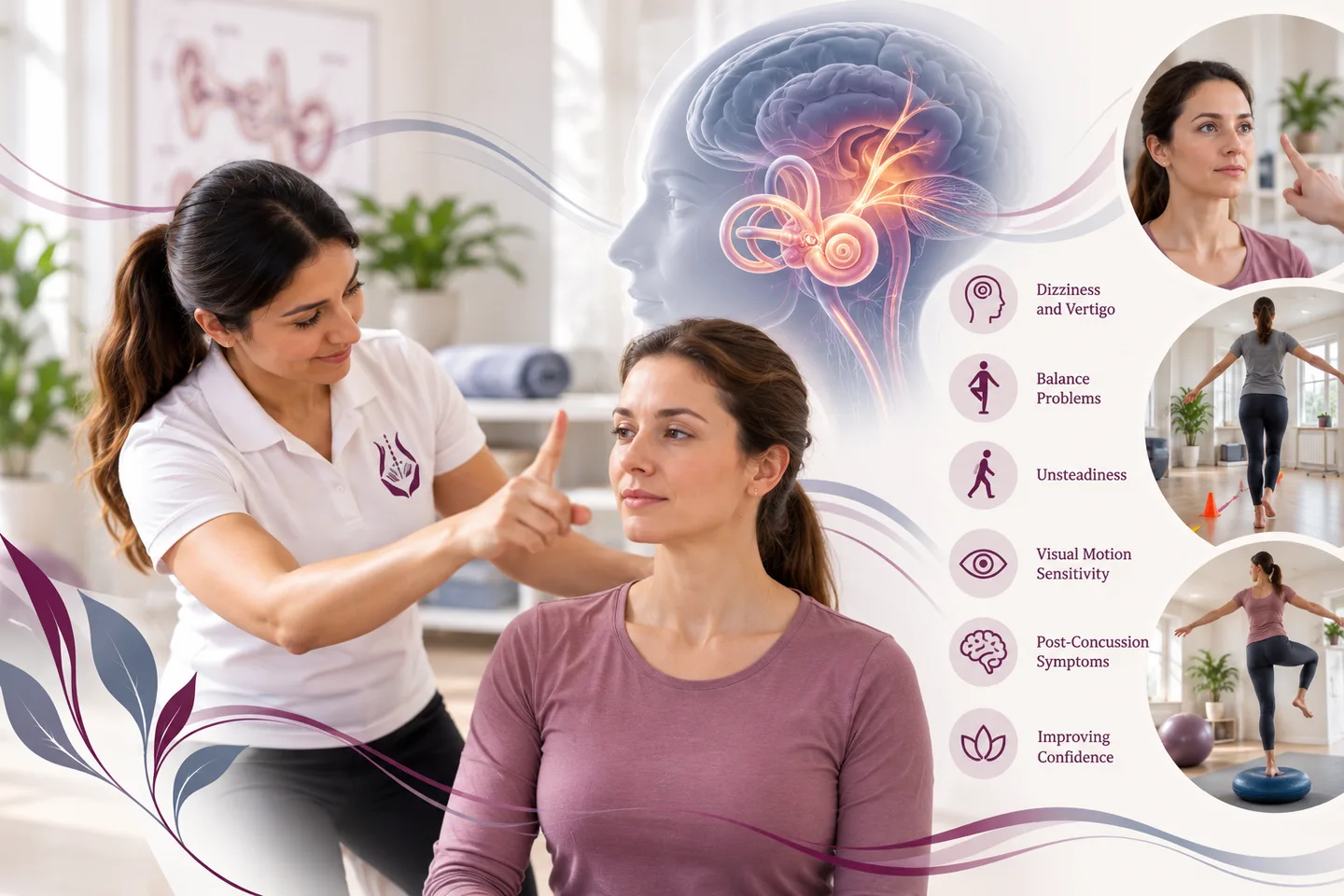
What people come to us with
These are the conditions and symptoms we most often see in this part of the clinic.
- Benign paroxysmal positional vertigo (BPPV)
- Vestibular neuritis
- Labyrinthitis
- Persistent postural-perceptual dizziness (PPPD)
- Vestibular hypofunction
- Balance disorders
- Motion sensitivity
- Age-related balance problems
- Falls and recurrent falls
- Post-concussion dizziness
- Cervicogenic dizziness
Understand → Restore → Empower
Understand
A vestibular assessment: your history, how the dizziness behaves, eye movement and gaze testing, balance, and positional testing where it is indicated. The aim is to work out which system is involved before treating anything.
Restore
Depending on what we find: repositioning manoeuvres, gaze stabilisation, habituation work, balance and coordination training, gait retraining and falls prevention — progressed as your tolerance improves.
Empower
A home exercise programme and an explanation of what is happening, so you understand why a movement provokes symptoms and why doing it in a controlled way is part of the treatment.
What a programme may include
Built from your assessment, not a template
Not everyone gets all of these. Which of them apply depends entirely on what the assessment finds, and the programme is adjusted as you improve.
- Vestibular assessment
- Positional testing and repositioning manoeuvres
- Balance and coordination training
- Gaze stabilisation exercises
- Habituation exercises
- Gait retraining
- Falls prevention
- Movement re-education
- A home exercise programme
- Education about your condition
What we are aiming for
Less dizziness and vertigo, better balance, and — the part people mention most — the confidence to move normally again. Dizziness makes people cautious, caution reduces activity, and reduced activity makes balance worse. Breaking that loop is usually the real goal.
For older adults in particular, that means staying mobile and independent, and reducing the risk of a fall.

Questions people ask
What is the vestibular system?
A set of structures in the inner ear that sense head movement and position, working with your eyes and the sensors in your joints to tell your brain where you are in space. When one part of that system stops reporting accurately, the result is dizziness, unsteadiness or a spinning sensation.
How does vestibular rehabilitation work?
It uses specific, graded head, eye and body movements to help the brain recalibrate to the signals it is receiving. Some conditions, such as BPPV, may respond to repositioning manoeuvres instead. Which approach is appropriate depends entirely on the assessment.
Will the exercises make me feel dizzy?
Some of them may provoke mild symptoms, and in habituation work that is part of how it functions. We start at a level you can manage and build up. Tell us if it is too much — pushing through severe symptoms is not the goal.
How many sessions will I need?
It varies a great deal depending on the cause. We will give you an honest estimate after the assessment rather than before it.
Do I need a diagnosis from my GP or an ENT specialist first?
Not necessarily — you can book an assessment directly. Some causes of dizziness do need medical investigation, and if anything in your assessment suggests that, we will tell you and recommend you see your GP.
Do you treat dizziness that started after a head injury?
Post-concussion dizziness is one of the reasons people come to us. As with any head injury, if you have not been medically assessed since it happened, do that first.
Book a vestibular assessment
Call us to arrange one, or for a free, no-obligation chat about whether this is the right place to start.
Call To Book 07346 812150